Principles
Hankook & Company strongly supports and engages in UN SDGs (Sustainable Development Goals), an international commitment for the development of sustainable Earth.

Hankook & Company respects and complies with the UN Global Compact’s 10 principles in areas such as human rights, labor, environment, and anti-corruption.
-
Human
Rights- <Principle 1> Businesses should support and respect the protection of internationally proclaimed human rights; and
- <Principle 2> make sure that they are not complicit in human rights abuses.
-
Labor
- <Principle 3> Businesses should uphold the freedom of association and the effective recognition of the right to collective bargaining;
- <Principle 4> the elimination of all forms of forced and compulsory labor;
- <Principle 5> the effective abolition of child labor; and
- <Principle 6> the elimination of discrimination in respect of employment and occupation.
-
Environment
- <Principle 7> Businesses should support a precautionary approach to environmental challenges;
- <Principle 8> undertake initiatives to promote greater environmental responsibility; and
- <Principle 9> encourage the development and diffusion of environmentally friendly technologies.
-
Anti-
Corruption- <Principle 10> Businesses should work against corruption in all its forms, including extortion and bribery.
Hankook & Company is leading the sustainable development of the industry through WBCSD activities.
WBCSD (World Business Council for Sustainable Development) is a global organization consisting global corporates that are working together to accelerate the transition to a sustainable world.
In 2005, eleven internationally leading tire manufacturers, including Hankook & Company, have formed TIP (Tire Industry Project) under WBCSD. The TIP members have engaged in the research on how the raw materials of the tire and the entire process of manufacturing, use, and disposal have on the environment.
Hankook & Company is working hard to improve sustainability in society, economy and environment through the global platform GPSNR.

GPSNR (Global Platform for Sustainable Natural Rubber) is a global platform launched in 2018 by various stakeholders such as NGO and corporates within the value chain of natural rubber. Those in the value chain of natural rubber pursue to fulfill social responsibilities in various areas such as the regulations, human rights, environment, and transparent management within their states.
In particular, Hankook Tire & Technology declares the SNR Policy as a GPSNR Founding Member and will strive to improve the productivity and quality of natural rubber.
As a holding company, we establish and implement policies across key areas to clearly define the direction and principles of our sustainability management.
Each policy is reviewed and approved by the Board of Directors, supporting responsible management across the company and reinforcing a transparent decision-making framework.
We actively adhere to and implement the following Ethical Management Principles as the standards for value judgment and conduct.
1. Compliance with Laws and Principles
We faithfully comply with applicable domestic and international laws, regulations, and international conventions and practice ethical and transparent management.
2. Respect for Customers
We place customers as our top priority and strive to provide safe, high-quality products and services, thereby earning customer trust and satisfaction.
3. Trust of Shareholders and Investors
We enhance the value of shareholders and investors and secure long-term trust through rational and responsible decision-making.
4. Respect for Workers and Fair Opportunities
We provide equal and fair opportunities to all workers, respect diversity and inclusion, and support self-realization.
We also foster innovative and efficient working environments to create safe, healthy, and fulfilling workplaces.
5. Protection of the Environment and Human Rights
We protect the environment and contribute to addressing climate change, while respecting human rights and preventing violations in all business activities.
6. Responsibility to Local Communities and Global Society
We respect the laws and cultures of the countries and regions in which we operate and contribute to the development of local communities and the sustainability of the global society.
7. Information Protection and Responsible Management
We safely protect personal data and corporate information and maintain a responsible approach in the use of digital technologies and emerging technologies.
8. Ethical Leadership and Practice
All workers, including executives and employees, are expected to lead by example and practice ethical behavior.
Where violations occur, we respond promptly and establish a sound ethical culture through internal reporting mechanisms and whistleblower protection systems.
Safety and Health Management Principles
- - We recognize safety and health management as a top priority within our management strategy and continuously carry out activities to prevent all occupational injuries and work-related illnesses.
- - We establish and faithfully implement internal management standards that comply with applicable safety and health laws, regulations, and other relevant requirements.
- - We assess safety and health impacts, set safety and health objectives, and pursue continuous review and improvement through systematic implementation.
- - We ensure the safety and health of all workers by eliminating hazards and reducing safety and health risks, and actively promote continuous improvement of the safety and health management system, including education and training.
- - We establish communication systems with workers, worker representatives, and all relevant stakeholders to provide information and encourage consultation and participation in safety and health management activities.
- - This Safety and Health Policy applies not only to workers of Hankook Tire & Technology but also to contractors, external partners, and all individuals engaged in work-related activities.
All workers, including executives and employees, shall understand and comply with this Safety and Health Policy and fulfill their respective responsibilities in establishing and maintaining an effective safety and health management framework.
Safety and Health Fundamental Principles
Responsibility for preventing and responding to accidents lies with the relevant organization and its reporting line.
All workers, including executives and employees, have a responsibility to work without causing safety accidents from their first day of employment.
Responsible Compliance with Rules and Standards
- 1. Hankook Tire & Technology establishes safety-related rules and standards and provides training on them, and all workers, including executives and employees, shall strictly comply with such rules and standards.
- 2. All policies and principles apply not only to workers of Hankook Tire & Technology but also to contractors, external partners, and all individuals engaged in work-related activities.
-
3. We comply with international standards, applicable laws and regulations, internal rules, and collective agreements related to safety and health. Key internal requirements include the following:
- - Appropriate personal protective equipment (PPE) shall be provided based on work processes, and workers shall wear the required PPE while performing their duties.
- - Regular emergency response drills shall be conducted to ensure prompt response in the event of emergencies and fires.
- - Safety rules and procedures shall be followed when operating hazardous machinery/equipment and when using chemical substances.
- - In the event of an accident, accident investigations shall be conducted in accordance with relevant procedures, and efforts shall be made to prevent recurrence.
- - For tasks involving musculoskeletal risks, the Company conducts hazard factor assessments to improve work methods and environments, and workers shall perform their work safely in accordance with internal rules.
Safety and Health Risk Management
- 1. All workers, including executives and employees, shall make efforts to identify potential hazards in advance, and Hankook Tire & Technology shall take actions to improve and mitigate such hazards.
- 2. We continuously improve hazardous risk factors to protect the safety and health of all workers, including those of suppliers and partners working on-site.
- 3. We recognize safety outside working hours as equally important as safety during working hours.
- 4. Workplace risks are managed through a risk assessment system. Identified risks are addressed by setting priorities, establishing action plans, and implementing improvements.
Continuous Improvement
- 1. We strive to develop technologies to achieve optimal safety and health management.
- 2. We advance the safety and health management system through continuous improvement of systems and processes.
- 3. Management and all workers, including executives and employees, make ongoing efforts to continuously improve the safety and health management system.
- 4. We establish and operate quantitative targets and implementation plans to improve safety and health performance indicators.
Stakeholder Communication
- 1. To enable consultation and participation with workers and worker representatives regarding safety and health issues, we operate and manage various communication channels such as the Occupational Safety and Health Committee and safety and health consultative bodies.
- 2. Through the SHE Committee under the Board of Directors, we ensure oversight of the implementation of safety and health management policies.
To achieve this, all executives and employees hereby pledge and act as follows.
Environmental Management Principles
- - We voluntarily comply with applicable domestic and international environmental laws, regulations, agreements, and other relevant requirements and actively implement environmental improvement initiatives related to our business activities.
- - We identify and assess factors that have significant environmental impacts arising from our business activities, set objectives accordingly, and implement actions to minimize such impacts.
- - To minimize environmental impacts, we protect the environment by eliminating risk factors and reducing environmental risks through environmental investments and operational improvements.
- - We promote the efficient use of resources and recycling to reduce environmental impacts associated with resource consumption.
- - We conduct education and capacity-building activities to enhance workers’ understanding and capabilities related to the environmental management system and transparently disclose and communicate our policies and environmental performance to stakeholders.
- - We establish and implement environmental management plans to fulfill and advance our environmental commitments to stakeholders and pursue continuous improvement.
All workers, including executives and employees, shall understand and comply with this Environmental Management Policy and fulfill their respective responsibilities accordingly.
Fundamental Principles
Environmental management system
- 1. An ESG Committee under the Board of Directors is established to deliberate and decide on key matters related to the implementation of environmental management policies and the improvement of environmental performance.
- 2. An ESG Strategy Committee composed of top management discusses and determines company-wide environmental management directions and key environmental issues
Protection of the Global Environment
- 1. We make continuous efforts and investments to protect the future of the global environment.
Environmental Management at Business Sites
To minimize environmental impacts at our business sites, we progressively reduce the input of resources required in the manufacturing process, expand recycling and resource recovery, and prevent the release of hazardous and polluting substances.
- 1. We establish various environmental objectives and strive to achieve them in order to implement environmental management practices.
- 2. We minimize energy consumption and reduce greenhouse gas emissions by improving energy efficiency and expanding the use of renewable energy.
- 3. We review environmental and health impacts to ensure the safe use of chemical substances and properly dispose of them in compliance with applicable laws after use.
- 4. We strictly manage waste in accordance with legal standards and reduce waste generation through recycling and other resource recovery initiatives.
- 5. We minimize adverse impacts on the surrounding environment, including water pollution, air pollution, soil contamination, and waste generation, arising from product manufacturing activities.
Water Resource Protection
Recognizing water as an essential resource for humanity and ecosystems, we manage water pollutants based on internal standards stricter than legal requirements and make efforts to protect water resources by recycling water used in production processes.
- 1. We manage water withdrawal related to products and services and reduce overall water consumption.
- 2. We expand the reuse and recycling of water to conserve water resources.
- 3. We minimize environmental impacts through the proper treatment of wastewater and water quality management arising from production activities.
Product Responsibility
We recognize the environment as a critical management factor for corporate sustainability and acknowledge responsibility not only for environmental impacts during manufacturing but also for those arising during product use.
From the product design stage onward, we continuously conduct research to reduce environmental impacts by considering the entire product life cycle.
- 1. From the development stage, we identify potential environmental impacts across the entire life cycle of products and services and strive to improve them.
- 2. We develop and manufacture products that promote sustainability through the use of sustainable raw materials and improvements in fuel efficiency, noise reduction, and durability during product use.
Climate Change
Recognizing climate change as an urgent global challenge with severe impacts on humanity and ecosystems, we strive to fulfill our corporate roles and responsibilities.
We support the Paris Agreement and will participate in global efforts to limit the increase in global temperatures to within 1.5°C by reducing greenhouse gas emissions and implementing climate change adaptation measures.
- 1. We minimize energy consumption and reduce greenhouse gas emissions by improving energy efficiency across our operations.
- 2. We reduce greenhouse gas emissions through the transition to renewable energy and the use of environmentally friendly energy sources.
- 3. We reduce greenhouse gas emissions through the introduction of innovative emission reduction technologies.
Supply Chain Management
We recognize that environmental impacts arising within the supply chain for product manufacturing are also our responsibility and work in cooperation with suppliers to reduce the environmental impacts of supplied products and services.
- 1. We conduct environmental and sustainability assessments when entering into contracts with suppliers and reflect assessment results in procurement decision-making.
- 2. We identify optimal transportation distances and select appropriate modes of transportation to reduce environmental impacts arising from the transportation of raw materials and products.
Compliance Evaluation
We establish policies and mid- to long-term performance targets for environmental factors that may impact the environment through business activities and regularly review progress to reduce environmental impacts.
- 1. We proactively identify and seek to reduce environmental impacts that may arise from the industries related to our business activities through cooperation with business partners.
- 2. We conduct environmental due diligence during mergers and acquisitions to identify and minimize environmental risks.
[Hankook & Company Environmental Targets]
| Strategic Direction | Strategic Target | Mid- to Long-Term Targets |
|---|---|---|
| Reduction of Greenhouse Gas Emissions |
2050 carbon neutrality |
• Reduce greenhouse gas emissions by 40% by 2030(compared to 2023) • Development and application of greenhouse gas reduction technology • Improve energy efficiency to reduce energy consumption |
| Minimization of Environmental Impacts |
Reduce waste generation by 30% by 2030(compared to 2023) |
• Reduction of waste generation in production processes • Increase the recycling of raw materials through the establishment of internal circular systems • Optimization of pollution prevention facilities Biodiversity conservation activities |
| • Reduce water consumptionby 30% by 2030(compared to 2023) |
• Reduction of water consumption in production processes • Increase the recycling of water through improvements to water circulation systems |
Communication
To ensure transparent disclosure of environmental impacts and related activities arising from our business operations, we actively communicate with stakeholders.
- 1. We continuously engage and communicate with internal and external stakeholders, including government authorities, workers, and suppliers, to assess and reduce environmental impacts arising from corporate activities.
Hankook & Company operates an ESG Committee under the Board of Directors, an ESG Strategy Committee chaired by the Chief Executive Officer, and a Supplier Committee under the ESG Strategy Committee to oversee the establishment and implementation of ESG policies and to systematically monitor compliance and ethical management across the entire supply chain.
To promote shared growth with our Suppliers, Hankook & Company shares this Supplier Code of Conduct with our Suppliers and expects our Suppliers to respect and comply with its requirements. This Code applies not only to Hankook & Company’s suppliers and their employees, but also to agencies, representatives, and contractors that have contractual relationships with Hankook & Company, as well as all lower-tier suppliers without a direct contractual relationship (collectively referred to as “Suppliers”).
Hankook & Company distributes this Code of Conduct to Suppliers prior to entering into a business relationship. We expect our Suppliers to familiarize themselves with the contents of this Code, share it with and provide training to their employees, and support compliance.
-
1. Compliance with Laws, Regulations, and Codes of Ethics- 1) Hankook & Company expects our Suppliers to comply with all applicable laws and regulations of the countries and regions in which they operate.
- 2) We expect our Suppliers to align not only with their own codes of ethics but also with Hankook & Company’s Supplier Code of Conduct.
-
3) We fulfill our corporate social responsibility by transparently disclosing ESG performance to stakeholders. For this purpose, we may request that Suppliers submit performance data, participate in due diligence, or take other necessary actions. All such requests and procedures are expected to be conducted in compliance with applicable local laws and regulations.
- (1) We may request information from Suppliers, including policies, programs, progress updates, and final performance results. In such cases, any information provided by Suppliers is expected to be used solely for ESG evaluation purposes and handled in accordance with each Supplier’s information security policies.
- (2) Where we determine that on-site audits are necessary, we may request a site visit and will provide prior notice to the Supplier.
- (3) In connection with ESG assessments and audits conducted by Hankook & Company, we expect our Suppliers to submit accurate and complete information in a timely manner. If any violation of applicable laws, relevant regulations, or this Supplier Code of Conduct occurs or is likely to occur, expect our Suppliers to promptly notify Hankook & Company. If false information is submitted during ESG assessments or audits, or if violations result in significant social or environmental impacts, the business relationship with us may be subject to appropriate measures, which may include suspension or termination of the business relationship, depending on severity.
-
2. Anti-corruption and Anti-bribery
- 1) Hankook & Company expects our Suppliers to comply with relevant anti-corruption and anti-bribery laws, including, but not limited to, the Improper Solicitation and Graft Act, the U.S. Foreign Corrupt Practices Act (FCPA), the U.K. Bribery Act, and applicable local laws in the countries and regions where they operate.
- 2) We expect our Suppliers not to, under any circumstances, offer, promise, give, authorize, solicit, or accept bribes, improper payments, gifts, or anything of value to or from any individual or entity.
- 3) We expect our Suppliers not to directly or indirectly provide bribes or improper benefits to government officials or public institutions for the purpose of influencing decisions, securing improper advantages, or obtaining commercial benefits.
- 4) We expect our Suppliers not to offer or accept gifts, entertainment, hospitality, donations, sponsorships, or travel expenses to or from government entities, Hankook & Company, or other stakeholders in excess of limits permitted by applicable laws and Hankook & Company’s policies.
(We recommend our Suppliers follow applicable thresholds and internal approval procedures.) - 5) We expect our Suppliers not to engage in embezzlement, misappropriation, or any other form of improper acquisition for the purpose of obtaining unfair or improper benefits.
- 6) We expect our Suppliers to maintain accurate books and records and ensure transparent disclosure and reporting in accordance with applicable laws and regulations, thereby fulfilling their financial accountability.
- 7) We expect our Suppliers to respect international trade requirements, including export controls on strategic materials and applicable economic sanctions.
- 8) We expect our Suppliers to establish and implement monitoring processes to minimize the risk of counterfeit parts or materials being included in products supplied.
- 9) We expect our Suppliers to take appropriate measures, in accordance with applicable laws and internal regulations, against employees who violate anti-corruption and anti-bribery requirements.
-
3. Respecting and Protecting Human Rights
-
1) Principles and Scope of Application
Hankook & Company expects our Suppliers to support and respect internationally recognized human rights principles and to proactively prevent and manage any involvement in human rights violations throughout their business activities. We expect our Suppliers to comply with all applicable laws and regulations of the countries and regions in which they operate and place the highest priority on human dignity, human values, equality, and non-discrimination.
This Code of Conduct applies to all Suppliers across the entire supply chain, including tier-1 and all lower-tier suppliers. We expect our Suppliers to communicate these standards to their subcontractors through contracts or internal policies and encourage alignment with equivalent or higher standards. -
2) Reference Standards
We expect our Suppliers to respect and implement internationally recognized human rights standards, including the International Bill of Human Rights, the principles of the United Nations Global Compact (UNGC), the UN Guiding Principles on Business and Human Rights (UNGP), the OECD Guidelines for Multinational Enterprises, and the UN Convention on the Rights of the Child.
We expect our Suppliers to also comply with labor laws and relevant regulations of the countries in which they operate. Where local laws conflict with international standards, we encourage our Suppliers to seek ways to apply the higher standard to the extent possible. -
3) Human Rights Due Diligence
Hankook & Company expects our Suppliers to establish and operate a human rights due diligence system to systematically manage adverse human rights impacts that may arise from their business activities and supply chains. Suppliers are expected to define the scope, coverage, and frequency of due diligence and designate responsible departments or individuals to oversee its implementation and results. Suppliers are also expected to report due diligence results and the status of major human rights issues to management and appropriately communicate relevant policies and procedures to workers and stakeholders. Suppliers are expected to document their due diligence processes and results and provide relevant information upon Hankook & Company’s request. -
4) Risk Identification
Hankook & Company expects our Suppliers to regularly identify and assess actual and potential human rights risks that may affect workers and other stakeholders throughout their business activities and supply chains. Risk assessments are expected to consider the characteristics of each workplace, type of work, form of employment, and vulnerable groups and to use appropriate methods, including document reviews, consultation with workers and stakeholders, analysis of grievance records, and on-site inspections. Identified risks are expected to be prioritized based on the severity and likelihood of their impacts, and the assessment results and supporting rationale are expected to be documented and maintained. -
5) Risk Improvement and Monitoring
Hankook & Company expects our Suppliers to establish and implement corrective action plans (CAPs) for identified human rights risks based on their priority, with clearly defined timelines, responsible persons, and specific actions. Where critical issues are identified, Suppliers are expected to immediately cease, eliminate, or mitigate the relevant risks and report the actions taken to Hankook & Company. Suppliers are expected to regularly monitor the implementation and effectiveness of corrective actions and take additional or supplementary measures where improvements are insufficient. Suppliers are also expected to cooperate with Hankook & Company’s follow-up verification, including document reviews and on-site re-audits, and retain relevant records for at least the period required by applicable laws or contracts. -
6) Human Rights Grievance Channels
We expect our Suppliers to operate internal grievance mechanisms that are accessible to all workers and stakeholders and ensure anonymity, confidentiality, and protection against retaliation.
We encourage our Suppliers to inform workers of the availability of Hankook & Company’s grievance channel set forth in Article 10, Supplier Grievance Mechanism and Corrective Actions. Where non-compliance with human rights principles or potential violations occur or are suspected within the supply chain, Suppliers may report such cases through their internal channels and, simultaneously, through Hankook & Company’s reporting channel. -
7) Human Rights Basic Principles
We expect our Suppliers to comply with the “Basic Principles” set out in Article 5 of Hankook & Company’s Human Rights Policy, including the prohibition of forced labor and child labor, non-discrimination and anti-harassment, freedom of association and collective bargaining, compliance with working conditions and livelihood stability, responsible supply chain management, protection of community rights, and personal information protection.
-
1) Principles and Scope of Application
-
4. Safety & Health Management
- 1) Hankook & Company expects our Suppliers to comply with all applicable occupational safety and health laws and regulations of the countries and regions in which they operate and establish and implement their own safety and health policies and procedures. Such standards and procedures are expected to be communicated and shared in a language understood by workers.
- 2) We expect our Suppliers to prioritize worker safety under all circumstances and prohibit any work, processes, or activities that do not comply with applicable safety rules, standards, or laws.
-
3) We expect our Suppliers to provide a safe, hygienic, and healthy working environment, including, at a minimum, the following:
- (1) Personal protective equipment and safety training
- (2) Emergency response training
- (3) First-aid kits
- (4) Fire extinguishers and emergency exits
- (5) Adequate ventilation
- (6) Appropriate temperature control
- (7) Adequate lighting
- (8) Safe drinking water
- (9) Washing and hygiene facilities
- (10) Appropriate seating
- (11) Changing, storage, and drying facilities (where workwear is used)
- (12) Hygienic dining facilities
- (13) Safe and appropriate dormitories (where provided)
- (14) Accessible and clean restrooms
- 4) We expect our Suppliers to prohibit the use, possession, distribution, or sale of illegal drugs at all workplaces.
- 5) In the event of an accident or incident, we expect our Suppliers to conduct root cause analysis (RCA) and implement corrective and preventive actions (CAPA) with defined timelines, including measures to prevent recurrence.
-
6) We expect our Suppliers to classify, label, prepare, maintain, and provide Safety Data Sheets (SDS) for chemical substances in accordance with applicable laws and regulations and ensure that workers receive training in a language they understand. Where management of change (MOC) is required due to the introduction of new substances or changes to facilities, processes, or operations, we expect our Suppliers to conduct hazard and risk assessments in advance, establish and document control measures, and reflect them in actual operations.
For operations located in the Republic of Korea, we expect our Suppliers to comply with legally required prior submission, registration, and reporting procedures related to chemical substances (e.g., new chemical substance requirements and submission deadlines). For overseas operations, we expect our Suppliers to comply with equivalent local standards, including the Globally Harmonized System of Classification and Labelling of Chemicals (GHS). We expect our Suppliers to also establish and operate procedures for responding to and reporting emergency exposure or leakage incidents. -
7) Safety and Health Governance, Worker Participation, and Contractor Management
We encourage our Suppliers to establish an occupational safety and health management system in accordance with applicable laws (e.g., a system equivalent to ISO 45001), operate safety and health committees or worker participation procedures, and fulfill contractor and subcontractor safety management obligations. This includes conducting joint risk assessments, sharing safety information, and managing on-site safety for contracted, subcontracted, or outsourced work.
For operations located in the Republic of Korea, we expect our Suppliers to comply with all obligations under the Occupational Safety and Health Act and its Enforcement Decree. -
8) Compliance with the Serious Accidents Punishment Act
For operations located in the Republic of Korea, Hankook & Company expects our Suppliers to comply with the Act on the Punishment of Serious Accidents and related subordinate regulations. In the event of a serious accident, we expect our Suppliers to immediately suspend the relevant work, evacuate workers from the affected area, and promptly report the incident to the Minister of Employment and Labor and other relevant authorities, in accordance with applicable laws. -
9) Notification of Violations
If a Supplier is subject to business suspension, administrative sanctions, fines, or criminal convictions due to violations of safety and health laws or regulations, the Supplier is expected to notify us in accordance with the notification criteria set forth in Article 1.3 of this Code of Conduct.
-
5. Environmental Management & Greenhouse Gas (GHG) Management
- 1) Hankook & Company expects our Suppliers to comply with all applicable environmental laws and regulations in the countries and regions where they operate and obtain, maintain, and renew all required environmental permits, licenses, and registrations.
-
2) We expect our Suppliers to make continuous efforts to reduce negative environmental impacts arising from their business activities, including the following:
- (1) Prevention and reduction of air, water, soil, and groundwater pollution, and the safe management and disposal of waste, hazardous substances, and noise
- (2) Expansion of renewable energy use and reduction of greenhouse gas emissions across the value chain, including the establishment of GHG inventories (Scope 1, 2, and, where applicable, Scope 3) and the development of emission reduction roadmaps
- (3) Utilization of energy-efficient and environmentally friendly technologies
- (4) Conservation of resources through reduction, reuse, and recycling, and substitution with renewable or sustainable materials where feasible
- (5) Conservation of biodiversity and prevention of damage caused by land use, including compliance with no-deforestation principles수
- (6) Compliance with national and international regulations related to animal welfare and animal testing
- 3) If a Supplier is subject to administrative sanctions, fines, or criminal convictions due to violations of environmental laws or regulations, the Supplier is expected to notify us in accordance with the notification criteria set forth in Article 1.3 of this Code of Conduct..
-
6. Responsible Minerals
-
1) Conflict Minerals
Hankook & Company and our Suppliers exercise due diligence throughout the entire supply chain to ensure that raw materials are not sourced from conflict-affected and high-risk areas where human rights are severely threatened.
Hankook & Company expects our Suppliers not to use minerals mined in conflict regions in the materials or products supplied to us and to provide verifiable documentation on the origin of such minerals upon request. Where necessary, we may conduct due diligence or audits of Suppliers in relation to conflict minerals. -
2) Responsible Minerals
We expect our Suppliers to comply with applicable regulations, including Section 1502 of the U.S. Dodd-Frank Wall Street Reform and Consumer Protection Act and the European Union Regulation (EU) 2017/821, and fulfill their responsibilities as responsible corporate citizens.
We encourage our Suppliers to ensure that the extraction and trade of minerals do not support armed conflict, human rights violations, or environmental destruction and to promote responsible mineral sourcing practices throughout the supply chain.
For the purposes of this Code, minerals sourced from conflict-affected and high-risk areas—including tin, tantalum, tungsten, gold, cobalt, nickel, mica, graphite, lithium, and copper—are defined as responsible minerals, and we encourage our Suppliers to exercise due diligence to ensure responsible sourcing.
-
1) Conflict Minerals
-
7. Protecting Confidentiality, Personal Data and Intellectual Property
- 1) Hankook & Company expects our Suppliers to protect personal data, financial information, health information, and other sensitive data of workers, suppliers, and customers in accordance with applicable data protection laws and regulations, including the General Data Protection Regulation (GDPR) and relevant domestic laws. We expect our Suppliers to establish and operate internal policies and controls for data protection.
- 2) We expect our Suppliers to collect and use personal data only for legitimate purposes and to the minimum extent necessary, and to comply with the principles of purpose limitation, data minimization, retention periods, and secure disposal.
- 3) We encourage our Suppliers to establish and maintain appropriate controls to protect intellectual property, trade secrets, trademarks, and confidential information. Such controls are recommended to include access management, encryption, logging, vulnerability management, and incident response measures as part of a robust cybersecurity framework.
- 4) We expect our Suppliers to handle confidential information provided by us in a lawful manner and in accordance with applicable laws and contractual agreements with Hankook & Company.
- 5) In the event of a personal data breach, ransomware attack, or other significant cybersecurity incident, or where there is a reasonable concern of such an incident, Hankook & Company expects our Suppliers to notify us without delay (and, where applicable, within 24 hours), and cooperate in investigation, containment, and recovery efforts. External disclosures, notifications to authorities, and communications with data subjects are expected to be made in accordance with Hankook & Company’s instructions.
-
8. Conflict of Interest
- 1) Hankook & Company expects our Suppliers and their workers to disclose in advance any actual or potential conflicts of interest that may arise in connection with business relationships with us and take appropriate measures to avoid or mitigate such conflicts. Where avoidance is not feasible, appropriate exclusion or mitigation measures are encouraged to be applied.
- 2) Where a family member or close relative of any of our workers, including executives and employees, is employed by a Supplier, or where any other circumstance exists that may give rise to a conflict of interest, such matters are expected to be promptly reported through the appropriate ethics, compliance, or legal channels. We may take measures such as reassignment of responsibilities to prevent conflicts of interest.
-
9. Fair Competition & Antitrust
- 1) Hankook & Company expects our Suppliers to comply with all applicable competition and antitrust laws and regulations and not seek improper advantages through unfair or illegal means.
- 2) We expect our Suppliers to prohibit cartel-related practices, including price fixing, bid rigging, and the allocation of markets or customers. We expect our Suppliers to also prohibit the improper exchange of competitively sensitive information (e.g., false statements or information theft) and not obtain confidential information without the consent of the rightful owner.
-
3) We expect our Suppliers to ensure that workers and contracted parties are fully informed of the above requirements and to accurately share and provide education and training on relevant laws and regulations.
If a Supplier violates applicable fair competition or antitrust laws or regulations, the Supplier is expected to notify us in accordance with the notification criteria set forth in Article 1.3 of this Code of Conduct.
-
10. Supplier Grievance Mechanism & Corrective Actions
-
1) Operation of Grievance Mechanisms
Hankook & Company expects Suppliers to establish and operate grievance mechanisms that allow for consultation, raising concerns, and reporting violations related to ethics, environment, labor and human rights, and health and safety.
Such grievance mechanisms are expected to be accessible, confidential, and designed to ensure timely, fair, and effective handling of reports. The mechanisms are expected to be aligned with the effectiveness criteria set forth in the UN Guiding Principles on Business and Human Rights (UNGP) and allow for the reporting of infringements on individual rights or legitimate interests. -
2) Anonymity, Confidentiality, and Non-Retaliation
We expect our Suppliers to protect the identity of reporters, including anonymous whistleblowers, and to prohibit any form of retaliation, such as dismissal, threats, or harassment.
All reports are expected to be handled promptly and fairly in accordance with applicable laws and procedures. We will ensure strict confidentiality with respect to all reports and inquiries received. -
3) Establishment, Communication, and Training on Reporting Channels
We expect our Suppliers to establish appropriate internal and external reporting channels through which violations or potential violations may be reported.
We recommend our Suppliers regularly communicate reporting procedures, protection measures, and responsible departments in a language understood by workers and to provide training on such procedures at least once per year.
※ Representative Reporting Channel
Where there is a suspected or potential violation of this Code of Conduct by Suppliers or their employees, or by any executives, employees, or other workers of Hankook & Company, such matters shall be reported without delay through the following channels:
* Ethics Management Reporting Email : ethics@hankookn.com
-
4) Investigation Procedures and Corrective and Remedial Actions
Where a grievance is received, Hankook & Company expects our Suppliers to establish and operate procedures covering the following steps: receipt → fact-finding investigation → determination → corrective and remedial actions → prevention of recurrence.
Where a Supplier’s business activities have caused or contributed to adverse impacts on supply chain sustainability, Suppliers are encouraged to provide appropriate corrective and remedial actions, taking into account the severity of harm, the rights of affected parties, and the importance of fair and effective remediation. Such actions may include, but are not limited to, suspension or mitigation of activities, restoration or compensation, engagement of third-party mediation where appropriate, and measures to prevent recurrence.
In determining corrective and remedial actions, meaningful consultation is encouraged to be conducted with affected parties or their legitimate representatives. -
5) Extension to Lower-Tier Suppliers
Tier-1 Suppliers are encouraged to incorporate this grievance mechanism and corrective action framework into their own internal policies and to promote and manage equivalent or higher standards throughout lower-tier suppliers (tier-n).
-
1) Operation of Grievance Mechanisms
-
11. Additional Requirements
- 1) Hankook & Company expects our Suppliers to provide regular training on the contents of this Supplier Code of Conduct to all workers, including full-time, part-time, dispatched, outsourced, and subcontracted workers, at least once per year.
- 2) For the sustainability of the entire supply chain, tier-1 Suppliers are encouraged to establish their own supplier codes of conduct and encourage lower-tier suppliers (tier-n) to comply with equivalent or higher standards. Tier-1 Suppliers are encouraged to implement appropriate measures to ensure compliance, including the retention of relevant evidence and documentation.
Hankook & Company applies this Policy to all suppliers that conduct business with Hankook & Company’s globally connected operations. Hankook & Company reviews and revises this Policy as necessary to reflect changes in international standards, laws and regulations, regulatory frameworks, and supply chain risks. We transparently disclose any revised Policy to stakeholders through the Company’s website and other appropriate channels. All revisions are finalized upon approval by the Board of Directors and senior management.
1. Sustainable Raw Material Sourcing and Environmental Impact Minimization
-
- 1) Scope and Principles
-
Hankook & Company seeks to minimize environmental and social impacts throughout the entire lifecycle of raw and auxiliary material sourcing and use. This Policy applies to the Company and all Suppliers across the supply chain, including tier-1 and all lower-tier suppliers.
We expect our Suppliers to avoid sourcing practices that cause illegal environmental damage or pollution and to comply with applicable national, regional, and local laws. We maintain management systems aligned with international standards to enhance transparency and accountability across the supply chain.
-
- 2) Biodiversity Conservation
- Hankook & Company expects our Suppliers not to source raw materials from areas of high biodiversity importance and not to engage in sourcing practices that cause deforestation, forest degradation, or the destruction of peatlands.
-
- 3) Climate and Energy Transition
-
Hankook & Company establishes and implements greenhouse gas reduction targets aligned with the Science Based Targets initiative (SBTi) across the supply chain in support of the Paris Agreement.
We aim to achieve net-zero emissions by 2050 and source 100% sustainable raw materials. We continuously promote improvements in energy efficiency and the expanded use of renewable energy across the supply chain.
-
- 4) Resource Efficiency, Pollution Reduction, and Circular Economy
-
Hankook & Company works to conserve water resources and prevent water and soil pollution, minimize air pollutant emissions, and identify and mitigate risks that may impact local communities and ecosystems, including noise and vibration.
We strive to minimize unnecessary resource use and emissions of hazardous substances and waste, while promoting a circular economy through the expanded use of bio-based and recycled raw and auxiliary materials.
-
- 5) Transparency, Corrective Actions, and Supply Chain Requirements
-
Hankook & Company expects our Suppliers to provide detailed information on the origin and sourcing locations of raw materials. We prioritize third-party verification based on global standards such as ISCC PLUS and ISO 14001 to enhance traceability and credibility. We continuously identify and monitor potential environmental impacts, and where adverse impacts are identified, we promptly implement preventive, mitigation, and corrective actions.
We expect our tier-1 Suppliers to apply and manage this Policy across lower-tier suppliers at an equivalent or higher level. We expect our Suppliers to retain and submit relevant compliance evidence and data and, where necessary, cooperate with verification activities, including document reviews and on-site inspections.
-
- 6) Compliance with the Sustainable Lead (Pb) Policy
-
Hankook & Company pursues responsible sourcing practices that reflect environmental, social, and ethical values, and adopts efficient resource utilization and ethical purchasing as its fundamental principles.
Accordingly, we comply with all applicable laws and regulations related to lead (Pb), as well as relevant customer requirements. We expect our suppliers to align with the same standards and, upon request, to provide relevant information regarding the sourcing, use, and management of lead. Where necessary, we may request supporting documentation and verify implementation through reviews and inspections, and, where appropriate, through improvement measures to support effective compliance and continuous improvement.
2. Respect for Human Rights and Labor Rights
Hankook & Company integrates respect for human rights and labor rights into its purchasing and supplier management practices and is committed to preventing involvement in human rights violations throughout its value chain.
We comply with applicable laws and regulations in all countries where we operate and place the highest priority on human dignity, human values, equality, and non-discrimination.
We respect and support internationally recognized human rights standards, including the International Bill of Human Rights, the principles of the United Nations Global Compact (UNGC), the UN Guiding Principles on Business and Human Rights (UNGP), the OECD Guidelines for Multinational Enterprises, and the UN Convention on the Rights of the Child. We seek ways to apply the higher standard to the extent possible where local laws conflict with international standards.
-
- 1) Human Rights Due Diligence
-
Hankook & Company requires and expects its suppliers to establish and operate human rights due diligence processes to identify, prevent, mitigate, and remediate adverse human rights impacts on stakeholders, including workers.
We expect such due diligence to include, at a minimum, risk identification, improvement actions and monitoring, internal and external communication, and grievance and remediation procedures.
-
- 2) Risk Identification
- We identify and evaluate human rights risks across the supply chain using stakeholder engagement outcomes, country/industry/region risk indicators, grievance data, and prior assessment results. We expect our Suppliers to cooperate in assessments and provide relevant information as requested based on this analysis.
-
- 3) Risk Improvement and Monitoring
-
We prioritize identified human rights risks based on severity, significance, and likelihood and requires appropriate corrective actions to be implemented where necessary.
Where critical issues are identified, we expect suppliers to take immediate corrective actions. We monitor the implementation status and effectiveness of such actions through our supplier governance and management processes.
-
- 4) Human Rights Grievance Channels
-
We operate and maintains grievance channels to prevent and address human rights violations within the supply chain.
We expect our Suppliers to ensure that Suppliers and their employees and other relevant stakeholders are informed of available grievance mechanisms and to cooperate with grievance handling processes, including internal mechanisms and, where appropriate, Hankook & Company’s grievance channel.
-
- 5) Fundamental Human Rights Principles
- We expect our Suppliers to comply with the “Basic Principles” set out in Article 5 of Hankook & Company’s Human Rights Policy, including the prohibition of forced labor and child labor, non-discrimination and anti-harassment, freedom of association and collective bargaining, compliance with working conditions and livelihood stability, responsible supply chain management, protection of community rights, and personal information protection.
3. Respect for Land Use Rights
Hankook & Company requires all Suppliers to strictly comply with applicable laws and regulations related to land acquisition, land use, and development in the countries where they operate.
We expect our Suppliers to respect local communities and the environment in the process of acquiring, using, or developing land and to secure land use rights through legitimate and transparent procedures. Where violations of land use laws or rights are identified, Hankook & Company may review the business relationship and take appropriate corrective or remedial measures.
4. Prohibition of Misconduct
Hankook & Company applies a zero-tolerance policy toward corruption, bribery, and any other forms of misconduct throughout its supply chain.
We are committed to ensuring free and fair competition and reserve the right to take necessary and appropriate measures to remediate harm where anti-competitive or unethical practices are identified.
Where misconduct is identified or suspected, all relevant parties are required to report such matters without delay through the grievance mechanisms set forth in Article 8 of this Policy. Reporters shall be protected in accordance with the principles of confidentiality and non-retaliation.
5. Hankook & Company Supplier Management Process
Hankook & Company ope`rates a structured supplier management process to integrate sustainability considerations into procurement decisions and supply chain management
| Process | Details |
|---|---|
| Commitment to the Supplier Code of Conduct |
• We require suppliers to annually commit to and comply with the Supplier Code of Conduct. • The Supplier Committee reviews the Code of Conduct on a regular basis and assesses alignment with newly emerging ESG requirements. |
| Supplier ESG Assessment and Due Diligence | • We conduct regular ESG assessments and due diligence for suppliers to identify and evaluate sustainability-related risks. |
| Identification and Management of Key Suppliers |
• We identify suppliers with significant impact on production as key suppliers and manage them with enhanced oversight. • The list of key suppliers is reviewed and updated annually based on risk exposure and materiality |
| Support for ESG Risk Improvement |
• Based on assessment results, we require suppliers with elevated risks to establish and implement improvement plans and continuously monitor progress. • Where a supplier receives an ESG grade of “C” for three consecutive assessment years, we may require corrective actions and grant an improvement period of up to six months. Failure to implement required improvements may result in termination of the business relationship. • Conversely, suppliers demonstrating strong ESG performance may be granted incentives, such as higher advance payment ratios or preferential consideration in sourcing decisions. |
| Supplier ESG Training and Capacity Building | • We provide ESG-related training and capacity-building programs to support suppliers in strengthening their sustainability management capabilities. |
| Governance and Board-Level Oversight |
• The Supplier Committee establishes ambitious ESG initiatives on an annual basis and reports implementation plans and performance outcomes to the Board of Directors. • Key issues arising from procurement and supply chain activities are also reported to the Board to ensure effective oversight and shared responsibility. |
6. Training and Disclosure
-
- 1) Training
-
Hankook & Company provides training programs to ensure that employees understand the importance of sustainable purchasing and are able to effectively integrate sustainability considerations into their daily procurement and supplier management activities.
Through such training, we strengthen sustainability awareness and build the capabilities required to implement sustainable purchasing practices.
-
- 2) Disclosure
-
Hankook & Company discloses information on our sustainable purchasing policies, performance targets, and implementation status through appropriate channels, including ESG reports and our website.
Such disclosures are updated on a regular basis to ensure transparency and enable stakeholders to clearly understand Hankook & Company’s sustainability efforts and commitments.
7. Confidentiality and Information Security
-
- 1) Confidentiality
- Hankook & Company processes confidential information and personal data only to the minimum extent necessary and within the defined purpose. We prohibit external disclosure or provision without prior consent or a legal basis.
-
- 2) Information Security
-
We manage access to information based on the principle of least privilege and grant, review, and revoke access rights on a regular basis.
We implement encryption for sensitive information during storage and transmission and operate continuous controls, including log monitoring, vulnerability management, and physical security measures.
Personal data is processed in compliance with applicable laws, including consent and notice requirements, and is securely destroyed using irreversible methods upon expiration of the retention period. Where cross-border data transfers are required, we comply with all applicable legal requirements.
In the event of a suspected or confirmed security incident, we require immediate reporting, in principle within 24 hours, and prompt implementation of containment, investigation, legally required notifications, and recurrence prevention measures.
8. Grievance Handling
-
- 1) Receipt of Grievances
-
Hankook & Company operates channels through all workers including executives and employees and other individuals or organizations may report procurement-related grievances or concerns.
※ Representative Reporting Channels
ㆍ Global: https://www.hankookandcompany.com/en/misconduct-reporting/misconduct-reporting-guide.do
ㆍ Korea: https://www.hankookandcompany.com/ko/misconduct-reporting/misconduct-reporting-guide.do
ㆍ Ethics Reporting Email: ethics@hankookn.com
-
- 2) Handling and Escalation
- Response measures are determined based on court precedents, regulatory guidance, and internal practices. Where a reported case involves a high likelihood of legal or regulatory violations, potential impacts on community rights, or significant reputational risks, response measures may be discussed at senior management or Board level.
-
- 3) Protection of Reporters
- We expect our Suppliers to collect and use personal data only to the minimum extent necessary for legitimate purposes and to comply with the principles of purpose limitation, data minimization, retention, and secure disposal.
Hankook & Company exercises due diligence across its entire supply chain to ensure that raw materials are not sourced from conflict-affected and high-risk areas where serious human rights violations may occur.
This policy is based on Hankook & Company’s commitment to comply with Section 1502 of the Dodd-Frank Wall Street Reform and Consumer Protection Act, the European Union Regulation (EC/2017/821), and its responsibilities as a responsible corporate citizen.
Through this policy, the Company aims to prevent mineral extraction and trade from supporting armed conflict, human rights abuses, environmental destruction, or other unethical practices, and to establish a culture of responsible mineral sourcing throughout the supply chain.
Policy Statement
Hankook & Company is committed to the responsible sourcing of the following minerals
Tin, Tantalum, Tungsten, and Gold (collectively referred to as “3TG Conflict Minerals”), and other Responsible Minerals, including Cobalt, Nickel, Lithium, Copper, Mica, and Graphite.
The Company evaluates and manages its supply chain based on the Responsible Minerals Initiative (RMI) and the OECD Due Diligence Guidance, and conducts transparent procurement activities that meet the expectations of customers and other stakeholders.
Supply Chain Requirements
All suppliers are required to comply with the following
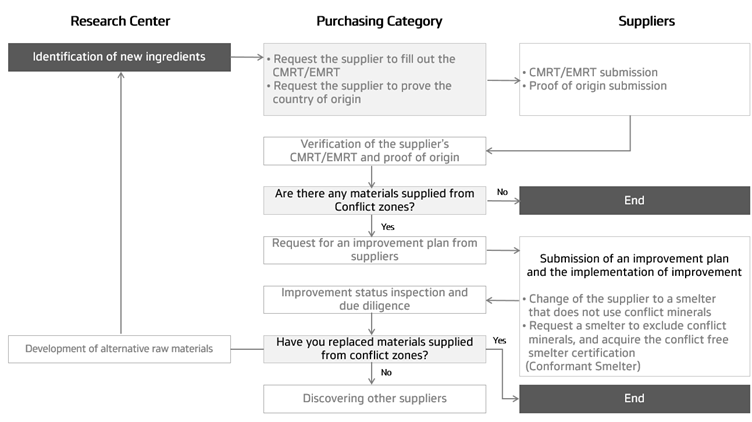
- 1. Suppliers shall not use minerals mined from conflict-affected and high-risk areas (CAHRAs), and shall submit country-of-origin documentation and RMI due diligence reporting templates (CMRT or EMRT) at least once per year.
- 2. Suppliers shall implement the RMI Responsible Minerals Assurance Process (RMAP) or an equivalent certification scheme within their supply chain.
- 3. Suppliers shall operate a due diligence process in accordance with the OECD Due Diligence Guidance or equivalent internationally recognized standards.
- 4. Suppliers shall cooperate in good faith with on-site audits or the submission of additional documentation upon the Company’s request.
Hankook & Company’s Commitment to Action
Hankook & Company promotes responsible mineral sourcing under the following principles
- 1. Compliance with all applicable laws and regulations in countries where the Company and its supply chain operate.
- 2. Conducting transparent supply chain due diligence in collaboration with suppliers and periodically sharing the results.
- 3. Establishing a long-term responsible minerals sourcing framework through cooperation with customers, suppliers, the RMI, and other stakeholders.
- 4. Promptly transitioning to alternative supply sources where unethical sourcing practices are identified, to the extent commercially practicable.
Assessment Process
Scope of Covered Countries
For the purposes of this policy, Conflict-Affected and High-Risk Areas (Covered Countries and/or CAHRAs) include:
The Democratic Republic of the Congo (DRC) and countries that share internationally recognized borders with the DRC, namely Angola, Burundi, Central African Republic, Republic of the Congo, Rwanda, South Sudan, Tanzania, Uganda, and Zambia.
Conflict-affected and high-risk areas as defined by the OECD and EU Regulation (EC/2017/821).
The list of covered countries is subject to regular updates and may be expanded beyond the DRC and its adjoining countries.
As a socially responsible corporate citizen, we comply with the laws of each country where we operate and contribute to the healthy development of society by respecting and protecting human rights. We place the highest priority on human dignity and value, fulfilling our responsibility to promote and uphold human rights throughout all business activities.
To fulfill our responsibility to respect human rights, we uphold and adhere to internationally recognized labor and human rights standards, including the International Bill of Human Rights, the principles of the UN Global Compact, the UN Guiding Principles on Business and Human Rights (UNGPs), the OECD Guidelines for Multinational Enterprises, and the UN Convention on the Rights of the Child. While we strictly comply with local labor laws of all countries of operation, in cases where local laws conflict with international standards, we seek ways to apply the higher standard to the extent possible.
-
1. Scope of Application- This policy applies to all stakeholders connected to Hankook & Company through its business activities. We are committed to preventing and addressing adverse human rights impacts on all stakeholders throughout our value chain, including all workers at our global operations (permanent, contract, temporary, foreign, and migrant workers, etc.) as well as employees of our suppliers and business partners, our customers, and local communities. Furthermore, we expect our suppliers and business partners to adhere to this policy and to ensure that their own suppliers and subcontractors also respect these standards.
-
2. Governance- The ESG Committee under the Board of Directors, the highest decision-making body for ESG at Hankook & Company, oversees ESG management activities, including ESG policies, goals, and performance. The ESG Strategy Committee, composed of senior management, establishes the strategic direction for key ESG priorities, including human rights management. Together, the Board-level ESG Committee and the executive-level ESG Strategy Committee play a vital role in supervising the overall human rights management system and deliberating on major human rights issues.
- The Society Committee convenes three times a year to review the implementation of human rights management, including strategies, processes, key indicators, target setting, and performance. Composed of executives and working-level representatives from relevant functions such as HR, Corporate Culture and ESG, the committee drives the continuous improvements and effective operation of the human rights management system.
-
3. Human Rights Due Diligence-
Hankook & Company has established a Human Rights Due Diligence process to identify, prevent, and remediate adverse human rights impacts on our workers and stakeholders. Through this process —which encompasses risk identification, improvement activities and monitoring, internal and external communication, and grievance and remediation procedures—we proactively detect human rights risks and protect human rights by implementing targeted improvement initiatives for such risks.
-
1) Risk Identification & Assessment
We identify human rights risk factors that may arise throughout our business operations and supply chains and evaluate their potential impact on stakeholders. To ensure a comprehensive analysis, we assess risks using both indirect data—such as stakeholder communication, risk exposure by country, industry, and region, and emerging issues—and direct data, including grievance reports, stakeholder feedback, and historical audit results. Based on these insights, we determine vulnerable stakeholder groups and select priority targets for assessment.
For these targets, we provide evaluation indicators and guidelines to conduct desktop assessments, followed by the establishment of improvement plans based on the results. Representative examples include the annual Worker Human Rights Impact Assessment and Supplier ESG Evaluation. If the desktop assessment results indicate the need for further verification of specific risks, we may conduct on-site due diligence measures such as interviews, physical inspections, and system audits. -
2) Risk Mitigation and Monitoring
We prioritize identified human rights risks by comprehensively analyzing their significance, severity and likelihood. Subsequently, relevant working-level departments establish and implement corrective action plans. For suppliers, immediate corrective action is mandated for critical issues. The Employee Committee continuously monitors the implementation status and effectiveness of these measures to ensure root cause remediation and mitigate adverse impacts.
-
1) Risk Identification & Assessment
-
Hankook & Company has established a Human Rights Due Diligence process to identify, prevent, and remediate adverse human rights impacts on our workers and stakeholders. Through this process —which encompasses risk identification, improvement activities and monitoring, internal and external communication, and grievance and remediation procedures—we proactively detect human rights risks and protect human rights by implementing targeted improvement initiatives for such risks.
-
4. Grievance Mechanism- Hankook & Company operates Grievance channels accessible to all stakeholders to proactively prevent and address human rights violations. If you witness non-compliance with human rights principles or cases of human rights violations, please report them through our dedicated channels. We are committed to seeking the best remedial actions for such reported cases, ensuring remediation for affected parties, and establishing recurrence prevention plans.
- Furthermore, critical issues are escalated to top management for the discussion of remediation plans. The identity of the reporter and the content of the report are kept strictly confidential and maintain a zero-tolerance policy against retaliation or any form of disadvantages toward the informant.
-
1) Human Rights Issue Reporting Channel & Handling Procedure
- (1) Ethical Management Reporting Channel
(https://www.hankookandcompany.com/en/misconduct-reporting/misconduct-reporting-guide.do) -
(2) Reports Handling Procedure:
[Receipt] → [Investigation] → [Resolution & Closure] → [Verification]
Step 1. Receipt: Official registration of the report.
Step 2. Fact-finding Investigation: Objective verification of facts and evidence.
Step 3. Resolution & Closure: Implementation of remedial actions and closing of the case.
Step 4. Verification of Results: Monitoring effectiveness and preventing recurrence.
- (1) Ethical Management Reporting Channel
-
5. Basic Principles-
1) Prohibition of Forced Labor
- (1) Principle: We strictly prohibit any form of forced labor that unreasonably restricts an individual’s mental or physical freedom.
-
(2) Management Areas
- Prohibition of all forms of involuntary labor—including debt bondage, forced overtime, forced prison labor, human trafficking, and modern slavery—that go against free will.
- Prohibition of withholding original personal documents, such as passports and identification cards.
- Prohibition of imposing recruitment fees on workers.
- Guarantee of freedom of movement and access to rest facilities, dormitories, and restrooms.
- Provision of important documents, such as labor contracts, wage deduction details, and regulations, in a language understood by workers.
- Guarantee of the freedom to resign (or terminate employment).
- Prohibition of utilizing supply chains involved in forced labor and implementation of regular monitoring.
-
2) Prohibition of Child Labor
- (1) Principle: We comply with the minimum employment age defined by local laws and regulations in each country and region and strictly prohibit child labor.
-
(2) Management Areas
- Prohibition of employing children under the age of 15.
- For young workers under the age of 18, prohibit assignment to night shifts, overtime work or duties that are hazardous to their safety and health, where such assignment would violate local laws.
- Implementation of age verification procedures during the recruitment process.
-
3) Prohibition of Discrimination and Harassment
- (1) Principle: We prohibit all forms of discrimination and respect Diversity, Equity, and Inclusion (DEI). Furthermore, we are committed to protecting workers from workplace harassment and sexual harassment, and we implement protection and remedial measures should any such incidents occur.
-
(2) Management Areas
- Prohibition of discrimination based on race, age, gender, nationality, ethnicity, disability, religion, pregnancy, union membership, marital status, social status, sexual orientation, political opinion, family status, physical condition, or medical history(disease).
- Provision of equal working conditions throughout the entire employment lifecycle, including recruitment, job assignments, promotion, training, wages, benefits, and separation.
- Payment of wages to both women and men based on equal criteria, and prohibition of all forms of gender-based discrimination.
- Commitment to respecting Diversity, Equity, and Inclusion (DEI) and fostering a culture of DEI.
- Prohibition of all forms of workplace harassment—including physical, psychological, and verbal abuse—and the protection of workers.
- Prohibition of all acts that cause sexual humiliation or discomfort, including workplace sexual harassment.
- Operation of victim protection and remedial systems in the event of an occurrence.
-
4) Guarantee of Freedom of Association and Right to Collective Bargaining
- (1) Principle: We guarantee communication opportunities between the company and all workers. In accordance with the labor laws of each country and region, we guarantee the freedom of association and the right to collective bargaining. Furthermore, we ensure no worker is subject to disadvantage for reasons such as joining, participating in, or forming a labor union.
-
(2) Management Areas
- Guarantee of workers' freedom of association.
- Recognition and respect for workers' right to collective bargaining.
- Prohibition of any disadvantage or unfair treatment resulting from joining, participating in, or forming a labor union.
- Gathering of opinions regarding the working environment and implementation of continuous improvements.
-
5) Compliance with Working Conditions and Livelihood Stability
- (1) Principle: We comply with all working conditions, including minimum wage, working hours, and leave, as mandated by the laws of each country and region. Furthermore, by providing an appropriate level of wages, we contribute to the livelihood stability of workers and the qualitative improvement of working conditions.
-
(2) Management Areas
- Compliance with laws and regulations related to working conditions, including working hours, holidays and leave, maternity/parental leave and social insurance enrollment.
- Discouraging excessive working hours, prohibiting forced overtime, and ensuring compensation for overtime work in accordance with local laws.
- Payment of wages exceeding the legal minimum wage and striving to ensure Living Wage to enable our workers and their families to maintain a decent standard of living.
- Prohibition of unfair wage deductions; in cases of legitimate deductions under relevant laws, detailed wage statements must be provided.
-
6) Responsible Supply Chain Management
- (1) Principle: We manage human rights risks that may arise in all business activities—from raw material procurement to consumption—and are committed to protecting stakeholders.
-
(2) Management Areas
- Prevention of human rights violations during production, distribution, procurement, and sales of raw materials, parts, equipment, and finished products.
- Stipulation of supply chain management principles through sustainable procurement policies and supplier sustainability guidelines and management of human rights within the supply chain based on these standards.
- Efforts to establish a sustainable supply chain through supplier support, training, and ESG assessments.
- Protection of all other vulnerable stakeholders within the supply chain.
-
7) Protection of Human Rights in Local Communities
- (1) Principle: We protect the human rights of local communities and residents in the regions where our business sites are located.
-
(2) Management Areas
- Respect for the rights of local communities and Indigenous Peoples, and prevention of adverse human rights impacts.
- Efforts to protect and support vulnerable stakeholders within local communities.
- Listening to and reviewing the opinions of local community stakeholders and striving to obtain Free, Prior, and Informed Consent (FPIC) in accordance with relevant international standards and national laws.
-
8) Personal Information Protection
- (1) Principle: We are committed to protecting the personal information of all stakeholders, including workers, suppliers, customers, and visitors.
-
(2) Management Areas
- Protection of stakeholders' personal information in strict compliance with the privacy laws of each country and region.
- Implementation of technical and managerial measures to protect information collected for business purposes, and continuous improvement of information security systems.
- Conducting regular inspections of data privacy compliance to prevent misuse, leakage, and unauthorized access.
-
1) Prohibition of Forced Labor
Declaration
- 1. We shall continue to create social and environmental values through economic and corporate activities and contribute towards revitalizing the local economy.
- 2. We shall fully practice contribution activities for quality satisfaction and customer safety with customer-oriented management activities.
- 3. We shall further enhance its efforts to minimize our environmental impact throughout its business activities and fully take part in conserving the local society and environment.
- 4. We shall remain entirely dedicated towards supporting the socially underprivileged or the equivalent, such as the disadvantaged in the local community, through the active return of created values to society.
- 5. Based on the fundamental philosophy of respect for human beings, We shall be at the forefront of building a healthy society by managing the health of its employees and providing medical support to local communities.
Characteristics and orientation
- 1. Our social contribution activities maximize the interconnection with its core businesses as part of its efforts to ensure that corporate capabilities result in social values.
- 2. Our social contribution activities refrain from engaging in any inconsistent and aimless activities and focus the company-wide capabilities on its leading social contribution programs.
- 3. Our social contribution activities set the orientation for practical solutions to the pending issues and problems surrounding local communities.
Hankook Donggeurami Partners
Hankook Donggeurami Partners offers new possibilities and opportunities for challenges to the socially vulnerable. It is a subsidiary-type standard workplace for the disabled established to contribute to the growth and development of our society, including the local community. Among the various social welfare activities already implemented by Hankook & Company, this project is designed for the socially vulnerable. It is the most important social contribution project in that it can provide a stable job.
We do not use tax rate structures or tax systems for tax avoidance, and we do not transfer generated profits to countries with low tax rates.
Hankook & Company recognizes that tax law compliance and tax risk management are important factors for contributing to national finances, securing
customer interests, and maximizing shareholder profits, and recognizes that they are essential conditions for sustainable management.
To this end, we have established and are operating documented standards and procedures for tax principles, policies, and risk management, and are pursuing
cooperative and constructive relationships with customs authorities to ensure accurate tax payment and reporting.
-
1. In order to faithfully pay taxes in accordance with the law, we strictly comply with domestic and foreign tax laws and regulations in all transactions to create economic and social value,
and accurately report and pay the amount of tax to be paid in accordance with tax laws and regulations. -
2. To ensure transparency of tax burden, we fully disclose relevant information to our stakeholders.
In addition, in order to protect stakeholders by ensuring the appropriateness of the application of tax laws, we are reporting tax amounts through an accounting firm for details prescribed by law. -
3. We do not engage in cross-border income transfers or tax avoidance transactions using differences in tax laws between countries, loopholes in the international tax system,
or tax havens, and we ensure that we are legally taxed according to the value created in each country where we conduct business activities. -
4. In transactions with related parties, the principle is arm's length transactions in accordance with the OECD Transfer Pricing Guide Line and the laws of each country.
For transfer pricing transactions with foreign related parties, a transfer pricing report is prepared and implemented with an external tax expert. We are managing the situation.
This Policy applies to all domestic and overseas business sites, subsidiaries, and employees of Hankook & Company. In addition, the Company will continuously review and promote the application of the principles of this Policy across its entire value chain, including first-tier suppliers and beyond..
Fundamental Principles for Biodiversity Protection
-
1. Compliance with International Standards and Regulations
Hankook & Company respects global biodiversity frameworks and standards, including the Convention on Biological Diversity (CBD) and the IUCN Guidelines for Protected Areas. The Company endeavors to comply with all applicable national, regional, and local environmental and biodiversity-related laws and regulations in the jurisdictions where it operates. -
2. Commitment to No Net Loss and Net Positive Impact
Hankook & Company continuously reviews measures to reduce biodiversity loss that may arise from its business activities. The Company aims to minimize adverse impacts and offset unavoidable impacts by pursuing a No Net Loss approach, while progressively seeking opportunities to enhance ecosystem health and achieve a Net Positive Impact. -
3. Precautionary Approach and Continuous Monitoring
For new business projects, facility expansions, and other major operations, Hankook & Company strives to identify, prevent, and mitigate potential environmental and biodiversity-related risks in advance. During ongoing operations, key environmental indicators are monitored, and improvement measures are reviewed and implemented as necessary. -
4. Collaboration with the Supply Chain and Local Communities
Hankook & Company works in collaboration with local communities to mitigate biodiversity-related risks and to support conditions that enable natural ecosystems to recover and regenerate. The Company also seeks to mitigate risks in high-risk areas by considering land-use change, habitat impacts, and other biodiversity-related factors across its supply chain.
Biodiversity Management Process
Site Location Analysis ▶ Identification of Dependencies and Impacts ▶ Identification of Risks and Opportunities ▶ Development and Implementation of Mitigation Plans ▶ Disclosure
Environmental Management Principles
- - We voluntarily comply with applicable domestic and international environmental laws, regulations, agreements, and other relevant requirements and continuously implement environmental improvement initiatives related to our business activities.
- - We identify and assess factors that have significant environmental impacts arising from our business activities, set objectives accordingly, and implement actions to minimize such impacts.
- - We protect the environment by reducing environmental risks through investments and operational improvements aimed at eliminating risk factors and minimizing environmental impacts.
- - We promote efficient resource use and recycling to reduce environmental impacts associated with resource consumption.
- - We enhance employees’ understanding and capabilities related to environmental management through education and capacity-building activities and disclose and communicate our environmental policies and performance to stakeholders.
- - We establish and implement environmental management plans to fulfill and advance our environmental commitments, including those made to stakeholders, and pursue continuous improvement.
All workers, including executives and employees, shall understand and comply with this Environmental Management Policy and fulfill their respective responsibilities accordingly.